
The Gloriously Messy Reality
Everyone tells you writing a children’s picture book will be magical. What they don’t tell you is that it will also be utterly humbling, occasionally maddening, and responsible for more cups of cold coffee than you care to count. If you’ve ever quietly harboured the dream of creating a picture book, or you’re already somewhere in the middle of one, wondering if it’s supposed to feel this chaotic, then pull up a chair, because this post is for you.
When I started writing and illustrating my watercolour picture book, I had this beautifully naïve vision of how it would go. I’d write something charming, illustrate it in watercolour, and somehow it would bloom into a finished book like a flower opening in a time-lapse video. Lovely, effortless, inevitable. I can tell your right now, that is not what happened.
What actually happened was a year of rewrites, a character who changed his name halfway through the process, a course taught by the man who gave an entire generation the creeps, and one absolutely pivotal Facebook comment from a legend called Sue. None of that was in the brochure. And honestly? I wouldn’t have it any other way.
What Nobody Tells You About Rewriting
(And Rewriting, and editing, and crying then Rewriting)
Forty-four pages can break you in ways that four hundred never could. There’s something almost cruel about it. The format is so small, so deceptively simple, that every single word carries enormous weight. You can’t hide a weak moment inside a long chapter. There is nowhere to hide. Every sentence has to earn its place on the page.
I rewrote the same forty-four pages more times than I’m entirely comfortable admitting. Each time I thought I’d cracked it. Each time, I hadn’t quite. And here’s what I want you to hold onto if you’re in that rewriting loop yourself right now . . . . the fact that you keep going back is not a sign that something is wrong with you or your story. It’s a sign that you care deeply about the work. Writers who don’t care stop rewriting. Writers who do care keep going until it’s right. The rewriting is the writing. It just doesn’t look as pretty on an Instagram grid.
The emotional rollercoaster of revision is real and it is relentless. One afternoon you’ll read what you’ve written and think it’s genuinely wonderful. The next morning it’ll feel flat and wrong and you’ll wonder if you’ve imagined the good version entirely.
This is normal. This is part of the process. The trick, I’ve come to believe, is learning to trust the version of yourself who thought it was wonderful, not to stop revising, but to keep revising with faith rather than panic.
The Unexpected Game-Changer
How a Legend from my Childhood Might Have Just Saved my bacon
Somewhere in the middle of all those rewrites, I made a decision that genuinely changed everything. I enrolled in R.L. Stine’s Masterclass. Yes, that R.L. Stine, the Goosebumps mastermind who made an entire generation of children sleep with the lights on and beg for the next book in the series all at the same time. My personal favourite has always been “It came from Beneath the Sink”.
If you grew up in the eighties or nineties, there’s a good chance the man had a direct hand in your love of reading. He certainly had a hand in mine.
What struck me most wasn’t just the writing advice, though that was invaluable. It was the philosophy underneath it, the understanding that children deserve to be respected as readers, that story is fundamentally about keeping someone turning the page, and that the simplest structural choices are often the most powerful ones.
R.L. Stine has written hundreds of books. He knows what makes a young reader lean forward. Studying his approach to storytelling reshaped how I thought about my own picture book in ways I hadn’t anticipated.
If you’re working on a children’s book and you haven’t explored his Masterclass, it’s worth every penny. Consider that a genuine recommendation from someone who came in somewhat sceptical and came out completely converted.

Facebook named my main character!
Now here is the story I love telling most, because it perfectly captures something that I think gets talked about far too rarely in creative communities, the power of building an audience before your book is finished.
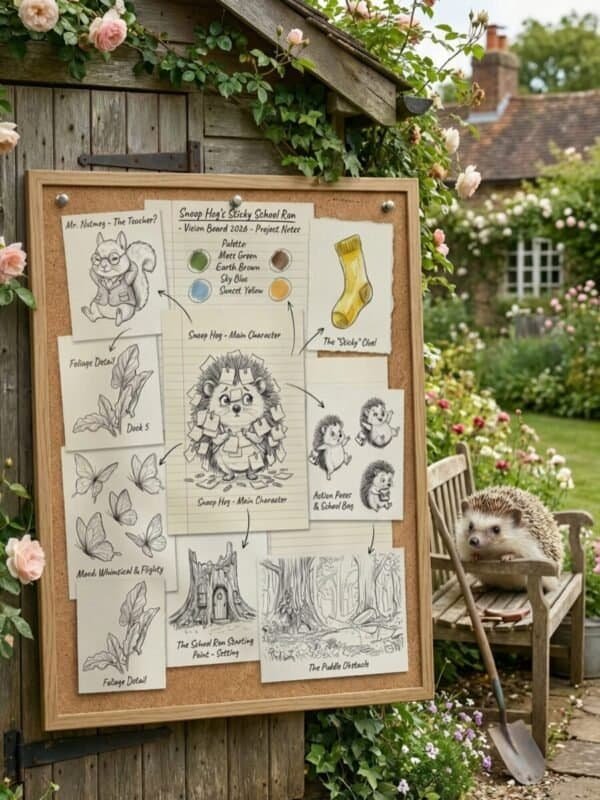
My main character, a hedgehog, since you’re asking, started life with a perfectly serviceable name. That name was Spike. Logical, right? He’s a hedgehog. He has spikes. Simple. Except that something about it felt too obvious, too expected, and it sat slightly wrong every time I read it back. I mentioned this in passing to my community online, just honestly sharing where I was with the project, and the suggestions started rolling in. And then Sue Herd commented and literally dropped the mic!.
She commented “me and Snoop Hog are really looking forward to reading it”. And just like that, with the kind of clarity that feels almost physical, I knew that was it. He was always Snoop. I just hadn’t met the right person to tell me yet.
This is what community does for creative work. It fills in the gaps you didn’t even know were there. It becomes part of the story itself. And there is something genuinely beautiful about the fact that people who follow your creative journey become invested in the outcome, that a reader named your character, and now that character belongs, in a small but meaningful way, to all of us. If you’re working on a creative project and you’re waiting until it’s finished to share it, I’d gently encourage you to reconsider. The people who come along for the messy middle become the most passionate champions of the finished work.
The Flip Book Trick Nobody Mentions
(But Everyone Needs)
A Practical Tip That Will Actually Change How You Work
Let’s talk about something genuinely practical, because amid all the emotional truth-telling, I want to give you something you can actually use.
When you’re working on a full-page picture book layout, particularly in watercolour, where the relationship between image and text is everything, one of the most useful things you can do is create a flip book version of your dummy. A small, physical, rough version of your book that you can actually hold in your hands and move through page by page. Not a digital file. Not a PDF. A thing you can flip.
This sounds almost embarrassingly simple, and yet it completely transforms how you see the pacing of your story. Reading a picture book on a screen, even in a beautifully formatted document, does not replicate the experience of turning a page. The turn itself is a storytelling tool. It creates anticipation. It delivers a reveal. It controls rhythm in a way that a scroll simply cannot. When you have a physical flip book in your hands, you suddenly feel where a page turn is working and where it’s falling flat. You feel the book’s heartbeat. You notice the places where your reader will slow down and the places where they’ll rush ahead, and you can start to make deliberate choices about both.
If you take nothing else away from this post, take that. Make the flip book. I use Flipbooklets.com, cause the owner Ben is a Brit and a legend! Simply create your PDF in Word, FREE Libra Office or Canva and you are good to go.
Here is a wee peek inside Snoop Hog, to prove my point.
Sneak Peek!The Philosophy That Makes It All Mean Something
Not every child gets it. Not every child has access to a stack of beautiful books or a grown-up with the time and inclination to read aloud to them every night. But every child deserves it, the magic of a story that feels like it was made just for them, a character they recognise, a world they want to visit again and again. That’s why the work matters. That’s why getting it right matters. That’s why I kept rewriting those forty-four pages instead of settling for the version that was merely fine.
When you knowwhy you’re making something, the how becomes easier to bear. Not easy . . . easier. There’s a difference. The why gives you somewhere to return to when the process gets hard, and the process will get hard. It always does. But a clear sense of purpose is the thing that makes hard work feel worth it rather than just exhausting.

This Story Is Still Unfolding And That’s the Point
Here’s the thing about sharing a creative journey in real time . . . it’s vulnerable in a way that sharing a finished product never quite is. When the book is done, you present it and then you wait. But right now, in this in-between space, I’m still finding out what this book is going to be. The story is still unfolding. And if you’re reading this, you’re already part of it, in the same way Sue became part of it with one perfectly-timed comment about a hedgehog called Snoop Hog.
There’s a particular kind of magic in being invited into something before it’s finished. You get to watch it become itself. You get to feel the difference between the messy middle and the polished end, and know that you were there for both. If that sounds like the kind of creative journey you want to follow, or if you’re in the middle of your own version of this, wondering if the chaos means you’re doing it wrong, then I genuinely hope this post has given you something useful to hold onto.
You’re not doing it wrong. You’re just doing it honestly. Which is, as it turns out, exactly how it’s supposed to feel.
Join the Journey — And Share Yours
If this post made you smile, gave you a useful nudge, or simply made you feel less alone in your creative chaos, I’d love for you to pass it on. Share it with anyone who loves children’s books, anyone who’s quietly working on a creative project of their own, or anyone who just needs reminding that the messy middle is not the failure, it’s the work.
Follow along here and on social media as Snoop the hedgehog makes his way from watercolour sketches to finished pages to something you can actually hold in your hands. And in the comments below, I’d love to know . . . . what’s the one thing nobody told you about your own creative journey? The floor is yours. Let’s make this a conversation.
Because every child deserves story time, and every creator deserves to know they’re not alone in the making of it.